

Endogas, generated in the furnace
We build continuous and chamber furnaces under protective gas for metallurgy and powder metallurgy: for carbonising, tempering, debinding and coating, for aluminium sintering and for heat treatment of individual components, foils, and piece goods and bulk material. Precise carbon control. Our sintering belt furnaces produce their own protective atmosphere: economical, controllable and matched to your PM parts. Atmospheres during heat treatment, sintering, annealing, tempering and hardening can be reducing, inert or oxidising. For demanding heat treatment, temperature and atmosphere profiles are controllable: they are analysed in the process, before feeding or on the product, and precisely controlled.
Endogas is produced in the furnace
Natural gas or propane and air pass over the catalyst; the heat is already there. The result is about 20% CO, 40% H₂ and 40% N₂. CO is the carbon carrier. One cubic metre of methane yields about five cubic metres of process gas. No hydrogen tank, no nitrogen store, no generator beside the furnace.
Carbon potential is a control variable
On a gear, a cam or a bushing, the surface is what counts. A decarburised layer of a few tenths of a millimetre costs hardness and fatigue strength. With endogas, carbon potential follows the air-gas ratio and is controlled by an oxygen probe and the CO content: neutral to the powder carbon, or deliberately carburising, for example before sinter-hardening.
Hydrocarbon in pure H₂/N₂ transfers carbon only slowly at sintering temperature and tends to form soot. The mixture becomes controllable only when CO is present.
For powders high in chromium or manganese, a very dry H₂/N₂ atmosphere can be the better metallurgical choice. For the classic Fe–C range, endogas is the more economical atmosphere and the one that can be controlled more precisely. CO and H₂ remain flammable. Safety functions and gas monitoring are part of the furnace.
Processes
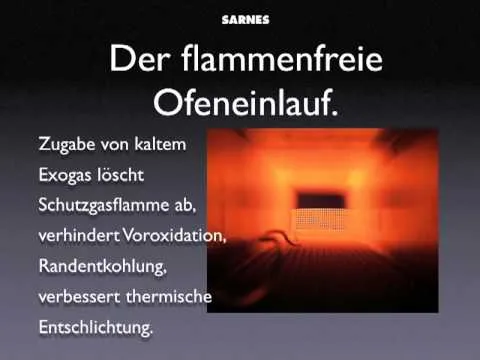
In the sintering furnace, as in sintering furnaces, burn-off (delubrication) and debinding come before sintering. Annealing and hardening follow under protective gas; the endogas is generated in the furnace.


Gas-heated SARNES continuous furnace with complete exhaust gas cleaning, shown during thermal desizing of glass fibres. 2:11 min on YouTube. Watch video